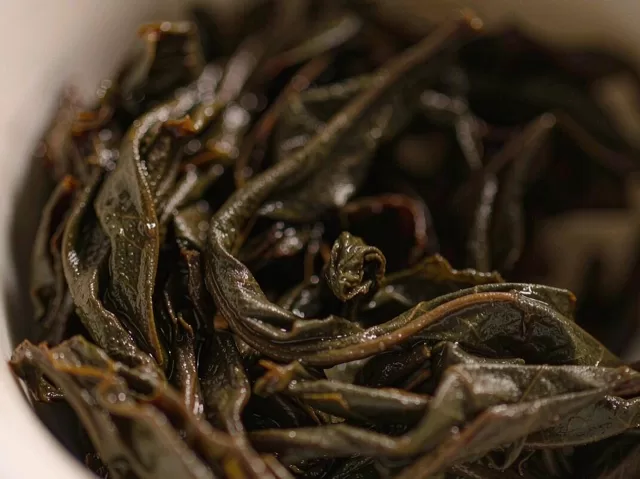
Most people who tell you they dislike oolong have never actually tasted oolong. They have tasted water that was too soft, a pot that had already gone cold, and leaf that was given no room to open.
Yancha is judged on 岩韵 — the wet-stone, mineral quality that only surfaces when nothing else in the cup competes with it. Chlorine, or water carrying more than roughly 150 ppm of dissolved solids, flattens that quality first and fastest. Filtered or low-mineral bottled water is not a luxury here; it is half the recipe.
Start with water that tastes of nothing
Temperature is the second variable people get wrong. Roasted rock oolong is not a delicate spring green: it wants a full rolling boil, and it wants the vessel to still be hot when the leaf goes in. A gaiwan rinsed with boiling water and drained takes about fifteen seconds to lose that heat — pour faster than that.
If the water has a flavour of its own, the tea has to argue with it — and tea always loses.
None of this is expensive to fix. A cheap filter jug, a kettle you actually like, and never leaving water sitting in the pot between pours will change a cup more than any upgrade to the leaf itself.
The three numbers worth remembering
- Leaf to water — roughly 7 g to 120 ml. Weigh it the first three times; after that your eye is calibrated.
- Water temperature — 100 °C for every roasted oolong. No exceptions, including the ones that say “don’t boil”.
- First steep — ten seconds, then add five seconds each round. Rock tea is a slow starter.
Brew the same tea twice, changing only the water. It is the fastest experiment you can run, it is the one most people never run — and it will tell you more about your oolong than any tasting note I could write.
What soft and hard actually mean
Water is not a blank ingredient. It carries calcium, magnesium and bicarbonate, and the total of those is measured as total dissolved solids — TDS, in parts per million. Tea is mostly an extraction problem, and those minerals change what gets extracted.
Below about 50 ppm the water is flat. The liquor comes out thin and slightly sour, because there is nothing in the water for the polyphenols to bind to — the body simply is not there. Above about 150 ppm the opposite happens: bicarbonate buffers the fruit acids, calcium binds the aromatics, and every tea starts to taste like the same mild brown note.
The window is roughly 50–120 ppm. Almost any supermarket low-mineral bottled water or a simple carbon filter jug lands inside it. A ten-dollar TDS pen settles the question in five seconds and pays for itself the first time you buy a good tea. Ignore anything sold as “mineral water”: those are frequently 300 ppm and above, and they will make a delicate Dan Cong taste like a wet brick.
The fifteen-second problem
Heat is the other half. A thin-walled glass pot loses twenty degrees in the time it takes to put the lid down. Porcelain holds better, and a preheated gaiwan better still — but only for about fifteen seconds, which is why the rinse matters and why you should pour before the leaf has finished settling.
If you are brewing in a mug with a basket, preheat it with boiling water for half a minute and accept that the first steep will run a little cooler. Compensate with one extra ten-second steep at the end rather than by grinding the leaf finer.
Never re-boil
Every time water comes to a boil it loses dissolved oxygen. Re-boiled water tastes flat and slightly metallic, and it makes tea taste older than it is. Fill the kettle with what you need, boil once, and do not leave water standing in it overnight — a kettle that has held water for twelve hours smells of the kettle, and so will your tea.
If your oolong tastes like wet cardboard, or like nothing at all, the leaf may well be fine. Before you buy a different tea, buy a filter jug and a thermometer. The two together cost less than one 50 g bag of yancha, and they will change every cup you make from here on.