Roasting is the only step in tea that is still judged by ear and by smell rather than by a thermometer. A roaster listens to the leaf in the basket — a dry rustle means it is ready for the next pass, a soft hiss means the moisture is still coming out — and smells the air above the charcoal. Everything else in tea-making has a number attached. This does not.
Which is why roast level is the least understood thing on an oolong label, and the one most worth learning to read. Light, medium and traditional are not a scale from bad to good. They are three different products with three different jobs.
What roasting is actually for
Freshly finished oolong is green, floral, and slightly raw. 焙火 bei huo — the slow bake, traditionally over charcoal, now often over electric heat — does three things at once.
It drives off moisture, which is what makes the tea keep. It runs Maillard reactions between sugars and amino acids, which is where the baked-fruit and honey notes come from. And it polymerises catechins, which takes the sharp green edge off the mouthfeel and turns it rounder and heavier. None of those three is reversible.
It also stabilises. A traditional roast will hold for a decade in a sealed tin and improve for the first five years. A light roast fades in months — the aromatics that make it lovely in June are gone by Christmas.
Three levels, three jobs
Light — 轻火
Sixty to eighty degrees, a few hours, one or two passes. The point is drying, not transformation: the leaf keeps its jade colour and its gardenia-and-cream aromatics, and picks up a faint toasted edge on the finish. This is the roast for high-mountain oolong and for Dan Cong, where the whole reason you bought the tea is the aroma and you do not want to cook it off.
Drink it within a year. Store it cold if you are keeping it longer than that.
Medium — 中火
Ninety to a hundred and ten degrees, three to five passes over one or two weeks, with days of rest in between. The green edge goes; the aroma moves from gardenia to baked pear, honey and light caramel; the liquor darkens from pale gold to amber. Body increases noticeably without the leaf losing its identity.
This is the widest and most forgiving band, and for most drinkers it is the one to start with. It is also where you can most easily be sold a mediocre leaf, because a medium roast flatters almost everything.
Traditional — 足火
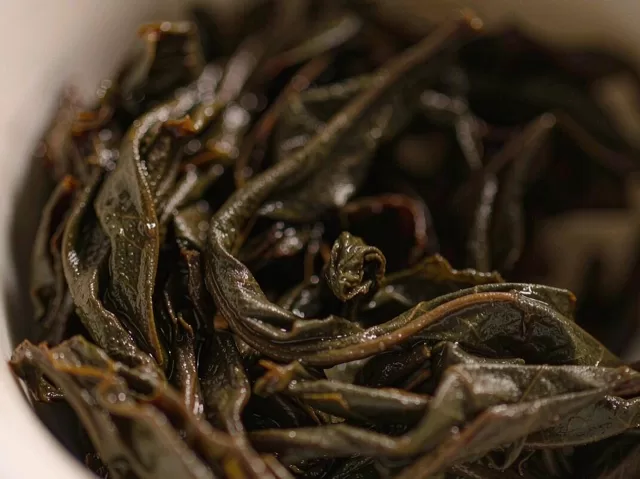
One hundred and ten to a hundred and thirty degrees, five to eight passes over a month, and often a re-fire after a year. The leaf goes from olive to mahogany, with a red rim on the edge of each leaf. The top notes burn off entirely — that is the intention, not a fault — and what remains is mineral, cocoa, dried longan, and, in yancha, the 岩韵 that the light roasts can only hint at.
Traditional roast is not “stronger tea”. It is a different drink: less perfumed, longer, cooler, and considerably more savoury. If you came to oolong for the flowers, this will read as burnt. If you came to it for the finish, nothing else comes close.
How to taste which one you have
- Look at the dry leaf. Jade green with a curled edge, almost no red: light. Olive-brown with red edges: medium. Dark brown, matte, a clear red rim: traditional.
- Smell the empty gaiwan after you pour the rinse off and the leaf is warm. Gardenia and cream reads light. Honey and baked fruit reads medium. Cocoa, roasted chestnut and a hint of char reads traditional. The empty vessel is more honest than the liquor.
- Count the steeps. In a 120 ml gaiwan, a traditional roast should give eight or more before it thins. If it dies at four, the roast was cosmetic — see below.
- Watch the colour, not the depth. Pale gold, amber, deep amber-red. The goal is clarity at every stage. A liquor that is dark and cloudy at steep two usually means the leaf was baked too hot for too short a time.
Rest is not optional
A freshly roasted tea is not drinkable. It smells of the roaster — dry, flat, slightly ashy — and the liquor tastes like the smell of a warm oven. Two weeks will settle a light roast; a traditional roast needs two to three months, and the difference between week two and week twelve is larger than the difference between two different teas.
This is why “freshly roasted” on a label is not automatically a good thing, and why a tea bought in April is often from the previous year’s roast, deliberately. Ask when it was fired. A shop that does not know has not rested it.
The dishonest shortcut
Roast hides defects. A leaf that was withered badly, or oxidized unevenly, can be baked until the sourness reads as “roast character” and the unevenness reads as “complexity”. It is the single most common way a cheap oolong is made to taste expensive for the first three steeps.
The tells are consistent. It dies early — four steeps and it is water. The char sits on top of the flavour rather than inside it, so the first sip is roasted and the second is thin. And the finish is dry rather than sweet: the back of your tongue goes papery instead of cooling. An honest traditional roast does the opposite on all three.
How we fire
Three passes for a medium roast, five for a traditional, with five to seven days of rest between each, and a re-fire once a year for anything we hold longer than twelve months. It is slow work with no measurable endpoint, which is precisely why it is the step worth paying attention to when you choose a tea.
The fastest way to learn all of this is to buy the same tea at two roast levels and taste them side by side, same water, same vessel, same morning. Two sessions and the labels stop being abstract. That is a much better use of forty dollars than one more bag of something you cannot place.